


Ipacol
Reports
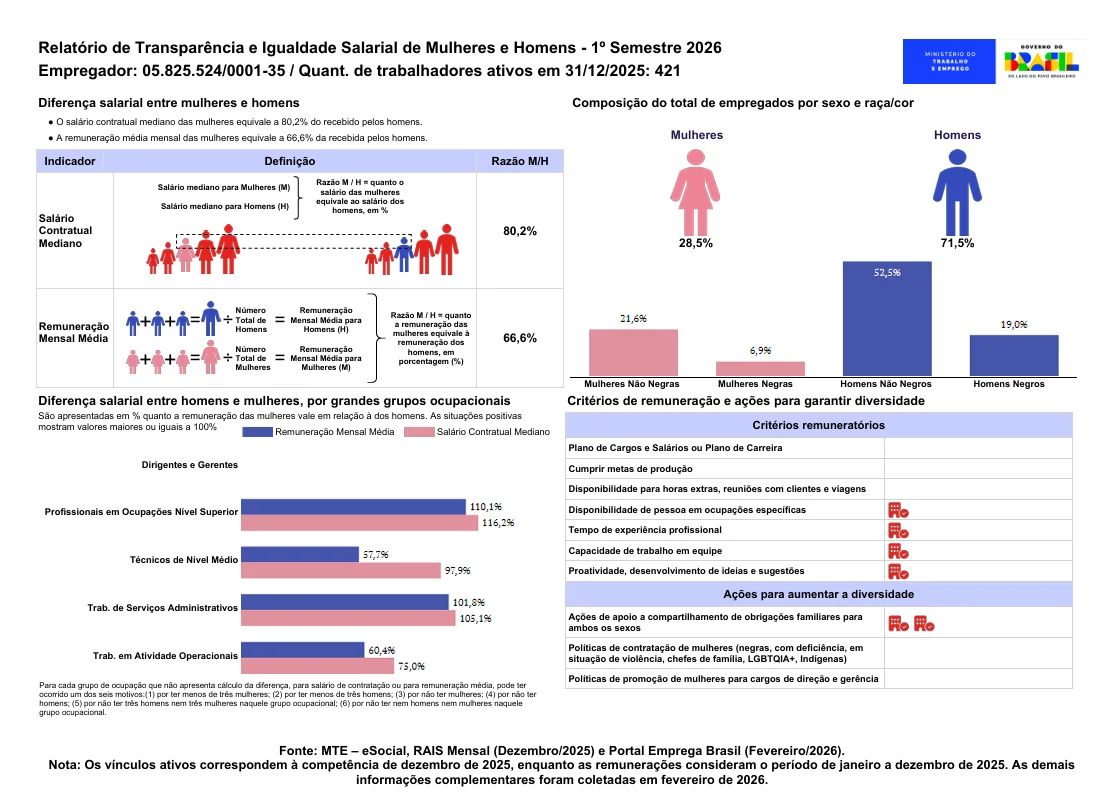
Transparency and Salary Equality Report
EXPLANATORY TECHNICAL NOTE:
The report now published was prepared by the Ministry of Labor and Employment (MTE) and made available to the Company on September 26, 2025, based on information extracted from the eSocial system, relating to the year 2024, and discloses information considering the 10 major groups of the CBO (Brazilian Classification of Occupations).
Ipacol, under the terms of Law No. 14,611/23, Decree No. 11,795/23 and MTE Ordinance No. 3,714/23, is obliged to replicate the aforementioned document provided by the MTE, without having been given any opportunity for questioning, clarification or rebuttal.
The criterion used by the Ministry of Labor and Employment (MTE) to consolidate the data, namely the 10 major groups of the Brazilian Classification of Occupations (CBO), which encompass more than 2,600 different occupations/activities, results in a true distortion of the intended assessment of wage equality, insofar as the average remuneration was carried out based on the major groups, disregarding the peculiarity of each of the functions or positions, in which the remunerations differ.
2. The survey by the Ministry of Labor and Employment does not contemplate the special and specific provisions contained in collective agreements, in scattered legislation, nor the regulations provided for in article 461 of the CLT (Consolidation of Labor Laws), that is, it does not consider the length of service in a given function, it does not consider the length of service in the company, nor does it consider productivity and technical proficiency, which makes it impossible to correctly assess the existence of wage inequality, insofar as it compares totally different realities, whether of activity, function, responsibility and/or remuneration.
3. The methodology employed by the Ministry of Labor and Employment for the preparation of these reports lacks clarity regarding how regulated professions, as well as those with a legally defined minimum wage, were treated.
4. The remuneration criterion used in the report, which takes into account, for example, overtime, also distorts the assessment of wage equality, since the motivation for extra work performed by men and/or women is not considered in the calculation.
Finally, Ipacol states that the conclusion of the report, in its main objective, does not reflect the reality of the Institution, reinforcing that it complies with current legislation and defends wage equality without any discrimination based on sex, race, ethnicity, origin, or age.